Cardbriks Wall · by Junkbot
Students pick a template, pick their electronics, and build a working robot in one lesson. The wall holds the templates, the modules and the workbench. Nothing to lose, nothing to sort, and no bin of plastic bricks.
How the wall works
The wall replaces the storage room, the parts drawers and the instruction binders. Every lesson starts at station 1 and ends with a robot on the bench.
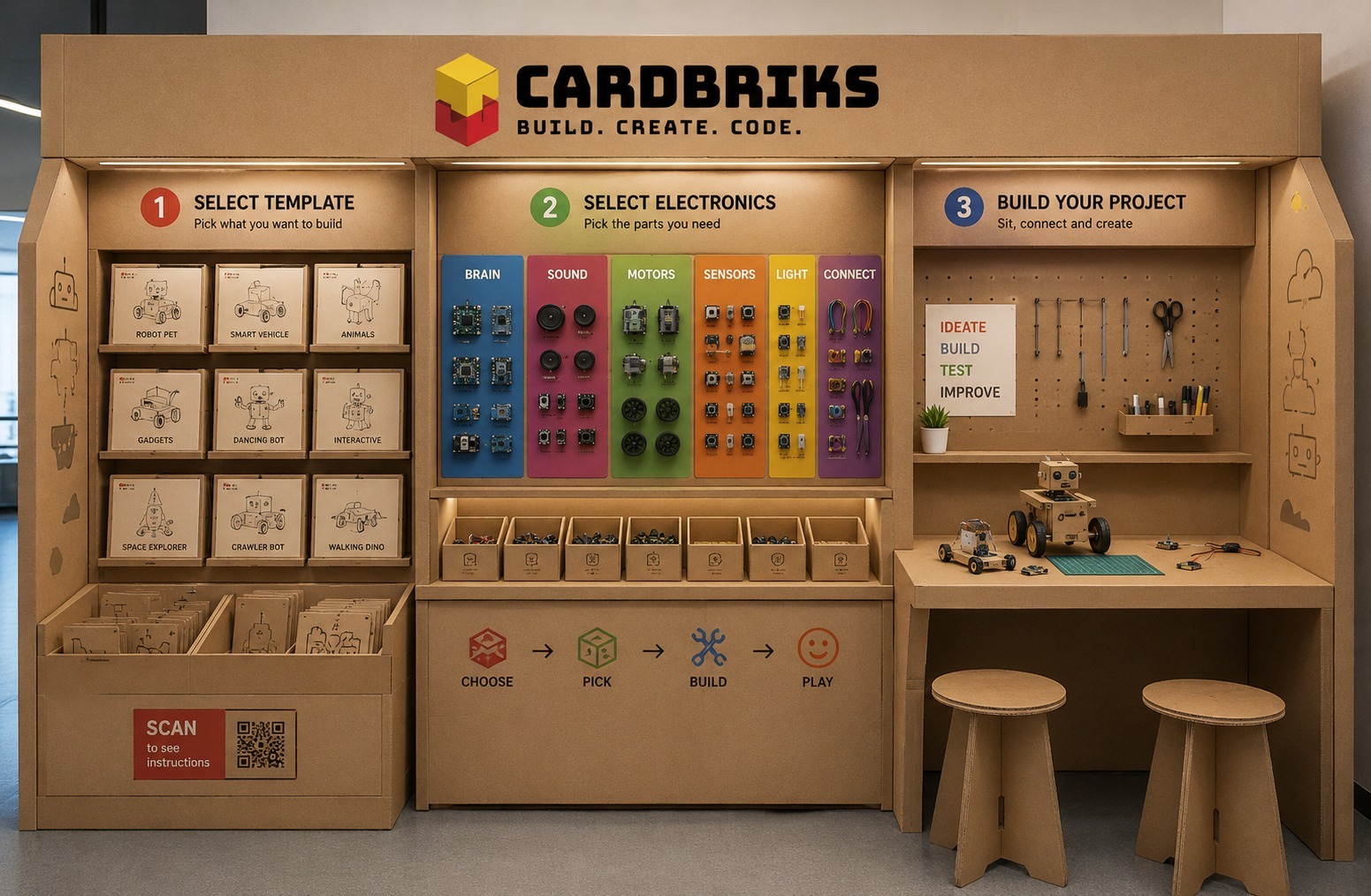
Die-cut cardboard templates for robot pets, smart vehicles, animals, gadgets, dancing bots, space explorers, crawler bots and walking dinos. Each one has a QR code to its illustrated guide on build.cardbriks.com, so students start without waiting for the teacher.
Colour-coded plug-and-play modules on the board, with spares in the bins below. The modules are the only durable parts on the wall, and they come back to the wall after every lesson to be used again by the next class.
A pegboard with scissors, cutters and markers, a cutting mat and two stools. Students ideate, build, test and improve at the bench, then code the brain with the Junkbot Core app when they are ready for the next step.
Templates & projects
Five kits, one per grade band, 12 projects each. Start with cardboard only, then add the electronics kit when the class is ready for sensors, motors and LEDs. The same projects stock the wall's template station.
build.cardbriks.com
Every kit has a free illustrated guide online: build along one step at a time, download the printable PDF, watch the build video, and read the grown-ups' notes on safety and wiring. Teachers can preview a whole project before the lesson. No login needed.
Learning through making
Cardbriks develops essential 21st-century skills through engaging, hands-on experiences. Whether you are teaching pure design thinking or diving into robotics, it adapts to your classroom.
Foster creativity through iterative prototyping and hands-on exploration of ideas.
Build structural understanding through modular construction and real-world problem solving.
Develop critical thinking by tackling open-ended challenges with tangible materials.
Encourage teamwork as students build together, share ideas, and learn from each other.
Pathway 1 · Pure design & making
Focus on design thinking, prototyping, structures and storytelling. The complete kit's cardboard templates and materials carry the whole lesson.
Pathway 2 · Electronics & robotics
Transform cardboard creations into interactive, programmable robots with the electronics kit, then the Junkbot Core Kit and the Sensors + AI Pathway Kit.
Cardbriks aligns with major curriculum frameworks, making it easy to integrate into existing lesson plans.
Science, technology, engineering, arts and mathematics integration.
Hands-on making and iterative design processes.
Preparing students for the future workforce.
For schools
One wall serves a whole school. It is delivered installed, with a curriculum mapped to your framework, your teachers trained, and a termly refill of templates. It fits a corridor, a library corner or a classroom back wall.
| Footprint | 3.6 m wide × 2.4 m high × 0.6 m deep, flat against a wall |
|---|---|
| Power | One socket for the shelf lighting; modules run on rechargeable packs |
| Class size | Up to 30 students per session, in pairs or trios |
| Lesson length | 45 to 60 minutes from template to moving robot |
| Ages | KS2 to KS3 / Grades 3 to 9; a KS4 extension with the Core Kit |
| Reset time | 5 minutes: modules back on the board, templates in the bin |
| Plastic brick kits | Cardbriks Wall | |
|---|---|---|
| Lost pieces | Every set loses parts; a missing piece stops the build | Templates are consumable; modules are counted back on the board |
| Storage | A cupboard of boxes and sorting trays | The wall is the storage |
| Creativity | Follow the manual, build the model on the box | Cut, shape and decorate; no two robots match |
| Setup per lesson | 15 to 20 minutes to hand out and collect | Students self-serve from the stations |
| Growing with students | Buy a new kit for each level | Same modules, harder templates, then the Core Kit and AI |
| Sustainability story | Hundreds of ABS parts per set, hard to recycle | Cardboard that goes in the paper bin; modules reused for years |
Bring a class to Do It Lab or we bring a pop-up wall to you. Students build; your STEM lead watches a real lesson, not a slide deck.
One wall, one year group, one term. We train the teachers, run the first lesson with you, and share student work and rubric results at the end.
Extend to more year groups, add the Core Kit pathway, and enter a team in the Junkbot League. Procurement documents, KHDA/ADEK-ready curriculum maps and safety sheets are included.
For events
The wall is a crowd magnet: visitors see a cardboard robot moving within minutes and want to build their own. We bring the wall, the facilitators and the templates. You get a hands-on zone that runs itself and leaves no plastic behind.
One wall, two facilitators, a steady flow of visitors. Each build takes 15 to 20 minutes and every visitor leaves with their robot.
Best for school STEM weeks, open days, parents' evenings
Throughput 60 to 80 builds per 4-hour slot
Space 4 m × 4 m, one power socket
Two to three walls side by side with a themed template set for the event, branded header panels, and a showcase shelf for finished robots.
Best for book fairs, science festivals, mall activations, expos
Throughput 200+ builds per day, multi-day
Extras co-branded templates, human-vs-robot challenge course
A timed team challenge run on the wall: teams of four pick a template, add sensors and motors, and compete on a course. Judged live, with prizes.
Best for corporate CSR days, inter-school competitions, government youth programmes
Format 90-minute heats, 8 to 12 teams per heat
Pathway feeds into the Junkbot League finals at Do It Lab, AUS
Junkbot has organised three seasons of the DEWA Robotics and AI Challenge, the FOCP Sharjah Robotics League, Sandooq Al Watan Startup Founders and 1 Tank by 1trepreneur, and runs maker workshops at the Sharjah International Book Fair. Facilitators are trained Junkbot educators; every event comes with a risk assessment, a run-sheet and a post-event photo set for your communications team.
Impact research
We looked at what a typical plastic robotics kit is made of, what it costs the climate, and what happens to it at end of life. Then we compared it with a cardboard template plus reusable modules. The numbers below drive the calculator.
Model: a plastic kit shared by two students carries about 1.5 kg of ABS parts (excluding hub, motors and packaging) and is replaced on a three-year cycle, so 0.25 kg of new ABS per student per year, of which 91% is never recycled. Cardbriks: 0.6 kg of corrugated templates per student per year, plus a share of a module set that stays in use for five years (counted as 0.05 kg of ABS-equivalent per student per year). Figures are estimates to be refined with a full life-cycle assessment.
Impact calculator
Example starting point: a 300-student roll-out over three years. Edit any number.
Equivalents: 20 g per PET bottle, 170 g CO₂e per car km, 21 kg CO₂ absorbed per tree per year. The calculator uses the model described in the Impact section; it is an estimate for planning and communication, not a certified LCA.
Impact certificate
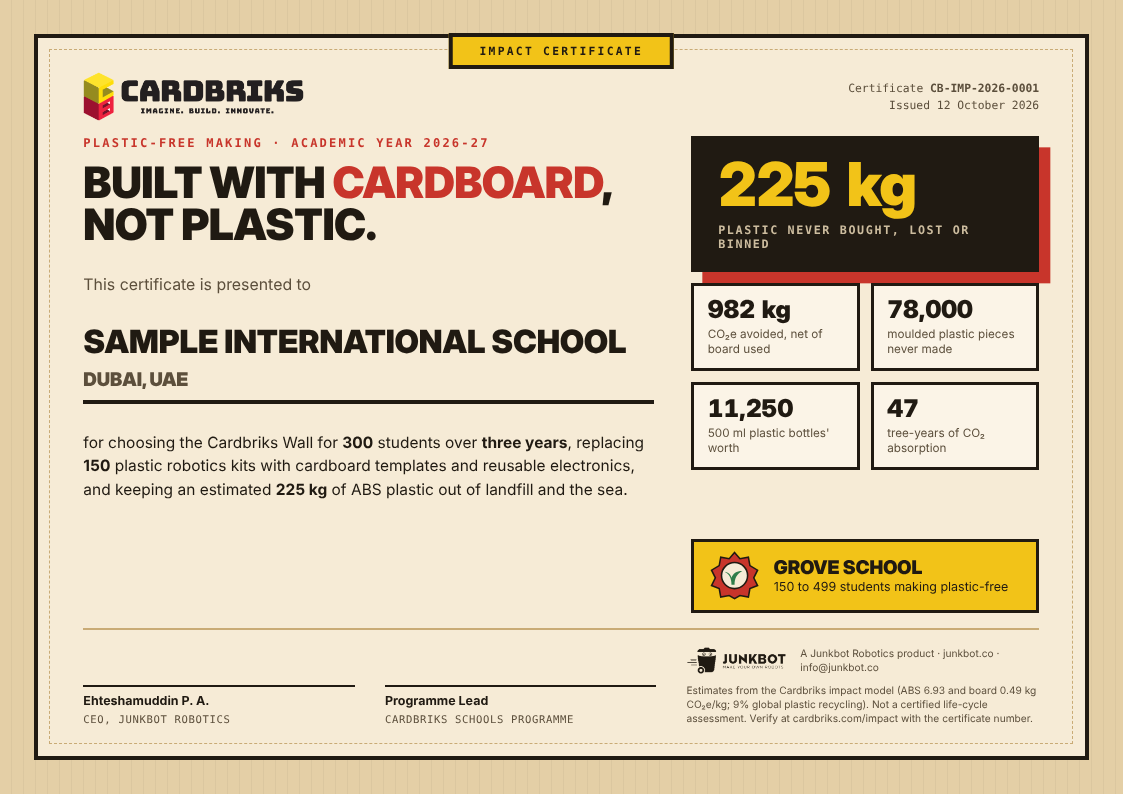
At the end of each academic year, Cardbriks issues a numbered Impact Certificate to every partner school, computed from the number of students who built on the wall. Schools use it in inspection evidence, sustainability reports, parent newsletters and award submissions.
Your calculator estimate above is the number that would appear on your certificate. Ask for a personalised preview with your school's name when you enquire.
Book a demo
Tell us about your school or event and we will come back within one working day with dates for a demo at Do It Lab or a pop-up at your site.
Do It Lab, American University of Sharjah, UAE. Serving schools across the UAE, Qatar and India.